


1. Producing Reliable Structural Data Through 3D Scanning Technology
Traditional surveys and archived drawings often fail to reflect the true condition of an existing structure. Over decades of use, buildings undergo:
- Undocumented structural modifications
- Service penetrations and openings
- Differential settlement and deflections
- Construction tolerances and execution deviations
To eliminate uncertainty, New Nordic deploys high-precision 3D laser scanning technologies to capture the building in its current state.
What 3D scanning provides:
- Exact spatial location of columns, beams, slabs, walls, and cores
- Accurate slab thicknesses and soffit profiles
- Verification of storey heights and structural offsets
- Detection of geometric irregularities and misalignments
The collected point-cloud data is then processed, filtered, and validated.
This step is critical — raw scans are not design-ready. Engineering validation ensures that only structurally relevant data is carried forward. The result is a verified spatial database, forming a digital twin of the structure that can be reliably used for analysis, coordination, and future reference.


2. Data Extraction and Preparation of Structural Models
Once spatial data is verified, the next step is engineering interpretation and model development.
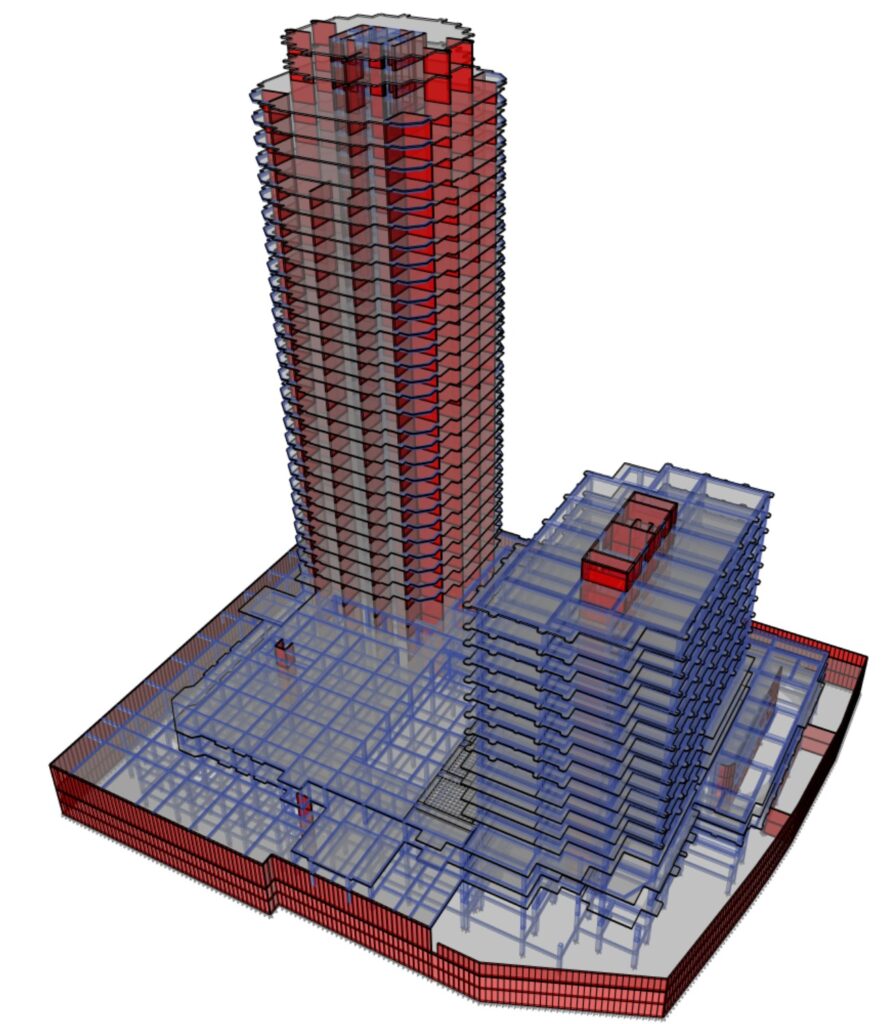
The extracted geometry is converted into analytical models using industry-leading software platforms, selected based on structural system and project requirements:
- ETABS for global structural behaviour, lateral load systems, and vertical load distribution
- SAFE for slab systems, foundations, pile caps, and local stress verification
- RAM Structural System for detailed steel, composite, or hybrid structures
- BIM-based models for coordination, clash detection, and lifecycle asset management
Key engineering considerations during model preparation:
- Accurate connectivity between structural elements
- Realistic support and boundary conditions
- Correct stiffness assumptions reflecting existing construction
- Calibration of material properties using test results and historical data
This phase bridges the gap between measured reality and analytical behaviour.
Every assumption is challenged, justified, and documented — especially critical in refurbishment and strengthening projects.

3. Structural Analysis and Safety Verification
With validated models in place, detailed structural analyses are performed to assess current performance, safety margins, and future capacity.
Analyses typically include:
- Gravity and lateral load assessment under existing and proposed conditions
- Verification against current codes and authority requirements
- Assessment of overstressed, under-reinforced, or deteriorated elements
- Evaluation of load redistribution and redundancy
Special attention is given to:
- Areas affected by new openings or structural alterations
- Change of use and increased imposed loads
- Progressive deterioration mechanisms
The outcome is a clear, evidence-based understanding of how the structure performs — not only today, but over its remaining service life.
Where deficiencies are identified, targeted strengthening strategies are developed to address real issues without unnecessary intervention.
Structural modelling, when executed correctly, becomes a risk management and optimisation tool, not just a compliance exercise.
